
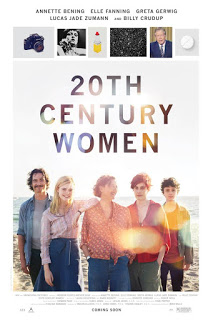
 Similar to the women of any century, 20th Century Women is one of the most overlooked films that received nowhere near the accolades it should have upon its January 2017 release. Starring Annette Bening, a single mother with a teenage son, struggling to raise him and raise herself simultaneously, in Southern California, in the late ’70s. In need of some financial support, Bening rents out rooms in her incredibly large yet personalized house creating a bohemian enclave that changes her and her son indefinitely.
Each woman depicted in this film contributes to the varied stages of womanhood and the struggles that may go with each stage. Dorothea, the main character, struggles with her own issues of aging, abandonment, parental role models, role modeling, and sexuality. William, the house handyman sees the beauty in women, all types of women, giving a hippie style and Dorothea’s hope that he will be a male role model for her son Jamie. She quickly learns that male and role models are not synonymous. Abby, the artsy photographer woman who rents out one of the rooms, also rents out a room in Jamie’s heart even though it was forced upon her with the assumption that all women are motherly. Abby eventual assumes the role model persona but discovers she had inside of her a woman she didn’t know existed. Julie, Jamie’s best friend establishes an unhealthy bond between the two of them that alters his perception about women and himself. Growing in a morally flexible yet stern household gave Jamie dysfunctional habits while grooming a feminist ideology without even realizing it.
What 20th Century Women teaches is worth its weight in gold. First and foremost, having a male around when you need a role model for your teenage son does not guarantee a bond and it does not mean that you stop parenting. At the same time, just because a woman has an abortion and isn’t ready to parent that does not mean she doesn’t want to be one or have the ability to parent someone else’s child, even if she doesn’t know that yet. Either way, judgment is unwarranted and no one else’s business. Another lesson learned is when you are a heterosexual teenage boy and your best friend is a very sexually active heterosexual girl, you have a very strong possibility of creating a natural attraction but sex is not always an option and should never be assumed or implied. Plus, teenage girls who are sexually provocative with you, but not sleeping with you are certainly struggling with sexual issues that require your friendship and acceptance without pressures of sexual relations. Lastly, women are complex creatures. Women never reach an age where life is figured out and begin to take on roles of mothering, marrying, working, single, International traveler or any other possible adult role. Women are learning, loving, and exploring possibilities from birth until death and this film explores that theme in a way that wakes up the idea of a woman in her many forms. 20th Century Women is the type of film that should be included in every academic class that focuses on film, sexuality, sociology, psychology, and literature. Everything from its complex storylines, to its human interactions, this film offers more than just 119 minutes of cinematic viewing. This film offers an education.
 Section 8 Agency
Leave a comment