
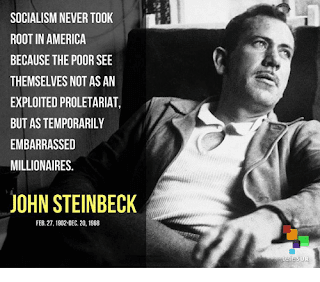
American Modernism writers fictionalize classes of people through lenses, taking a closer look at the microcosm of American culture. Writers such as F. Scott Fitzgerald, who wrote about the life he lived and longed to have, glamourizing the wealthy of American society while John Steinbeck wrote about the working and poverty classes of America depicting two sides to the same coin, the haves and have-nots. Both writers bookend the long list of writers in the literary canon of the American Modernism genre, teaching readers classism separates America simply by adding and subtracting economic value to what it means to be an American.
In this post, I will discuss through a Marxism lens, how value is applied and depicted in American Modernism literature. I will assert that American Modernism writers portrayed American culture by reflecting different socioeconomic classes who were either part of the haves or the have-nots. F. Scott Fitzgerald representing the haves and John Steinbeck representing the have-nots, these two American Modernist writers depicted classism of the working and elite classes creating a desire in readers to define Americanism by economic statuses in a way that classifies them as historians as well as writers.
A Little Bit of History
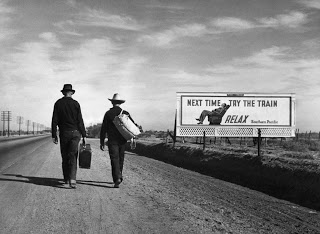
During the 1930’s American Mid-West and Southern Plains regions underwent what is called the Dust Bowl period. Severe dust storms swept through drought-dried lands causing ecological damage affecting farmers and inhabitants alike in what is considered a phenomenon. The dust clouds ”went as far as New York City” (History.com). Farm animals died and autopsies provided evidence that their stomachs were filled with dust, making the storm one of the deadliest to date. “The Dust Bowl intensified the crushing economic impacts of the Great Depression and drove many farming families on a desperate migration in search of work and better living conditions” (History.com). What little progress America had accomplished up until this point in these farming regions was now obliterated and people were forced to live by any means necessary. “A complex mixture of physical-environmental and socioeconomic pressures then contribut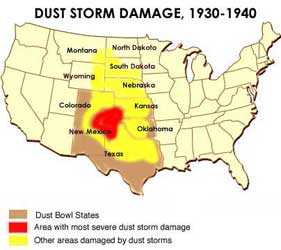 ed to large out-migration, with convoys of antiquated and heavily-loaded trucks taking migrants off to the new ‘Promised Land’ of the West Coast, especially California” (Gold 1). The impact of this event affected everyone. Steinbeck wrote The Grapes of Wrath about the migration of working, men and families due to the Dust Bowl. Steinbeck captures what happens when the model of Marxism is in place over the working class of American society and how it affects the poverty class. The have-nots, such as the Joads family struggle to pay their bills and put food on the table while the haves exercise their power over the have-nots regardless of their circumstances and how inhumane the actions may be. Whether we are talking about taking away a farmers home and land because they can’t pay the bank due to lack of work or denying workers right to safe working conditions, the bourgeoisie or haves are ready, willing, and able to oppress the proletariats.
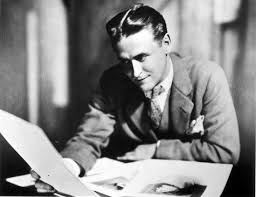
Fitzgerald wrote The Great Gatsby reflecting social consciousness, how class shapes the way we see ourselves, as well as how others see us. Jay Gatsby was born poor and fell in love with a rich girl named Daisy Buchanan. No matter how rich Jay became Daisy always saw him as the poor kid which effected how Jay saw himself. Fitzgerald goes even further into class struggles of the haves and have-nots by using two characters, Myrtle and George to represent the laborers. It is with these two characters Fitzgerald explores the effects of the bourgeoisie and the proletariats at odds without anything different between them except for their financial status. While George and Myrtle work on the cars of the rich and serve their gas station needs, it is the rich who symbolically and literally kill off the poor without any regards to the consequences of those actions. Fitzgerald offers insight into a working model of what happens when the haves set the standard for which all Americans should strive to become while taking away value from the have-nots labeling them as the undesirables.
Steinbeck and Fitzgerald write from two different perspectives about the same subject offering readers a multifaceted portrait of classism in American Modernist society. Karl Marx wrote extensively about the working class battles with wealthy class and how the power differential dictates how each class saw the other and themselves in it. While Marx pointed to what was wrong and why it was wrong, Steinbeck and Fitzgerald pointed to how it all plays out in everyday life. Marx drew invisible lines between the haves and have-nots, while Steinbeck and Fitzgerald inked the connections giving readers scenarios for how Marx’s theories played out. For readers, fiction looked a lot like non-fiction and both writers produced literary works that are utilized to study classism and the working class in a time in American history that still has palpable effects in modern American society.
Class War
Labor Power, as Karl Marx describes it gives power to the worker based upon the value of the production by the worker for the capitalist. “Labor power, therefore, is a commodity, neither more nor less than sugar,” so if the demand for sugar goes up, the value of it does (Marx, 659). Workers are often unaware of the power they wield, subjecting them to compliance in a Capitalist system that is set up to benefit from the labor force rather than encourage rising from its base society. Jay Gatsby rose through the ranks of the labor force in order to become part of the elite Capitalist class to redefine himself in society and change how others saw him. The problem is, in a Marxist Capitalist system, Gatsby was nothing more than sugar and never could be anything other than sugar regardless of his bank account status. Classism would not allow for Gatsby to be seen any other way.
 The value of the individual worker is based upon the exchange of goods and services, tied to social contact “the specific social character of each producer’s labor does not show itself except in the art of exchange” (Marx 668). The Wilson’s represented the base of Marxist society who worked for the elite class, producing a service that only benefitted the bourgeoisie, making them perfect examples of labor work force. The relationship between the Wilson’s and the elites is the art of the exchange in The Great Gatsby. Fitzgerald took creative license with the Wilson’s to kill the wife, Myrtle to demonstrate how the elite view workers as expendable. Since the value is placed on the productions of labor and not the laborers themselves, Myrtle is a dime a dozen and therefore her life is meaningless in this model. The refined elite model of East Egg is contrasted with Myrtle’s vulgarity making it easier to identify the class difference and set up markers for social classism.
Steinbeck utilized The Grapes of Wrath to show readers what life was like for the labor force during the Depression era and “sought to protest labor problems and social disparities” (Goggans 10). The Capitalist elite owns the means of production; families such as The Joads are subject to inequality in the labor force with drought in employment. America’s goods and services were dependent on a labor force that was viewed as equal to the goods and services they produced and by every standard was reduced to a zero value. Steinbeck depicted how this model when put into motion creates exploited workers who will migrate to follow the jobs in order to survive, enduring great amounts of poverty, and accept the exploitation out of a desire to survive. The elite saw this class struggle as a means to gain cheaper labor reducing the value of their laborers below the value of the goods and services they produced for the elite. Where Fitzgerald was writing about laborers manipulating the game in their favor regardless of the unfavorable outcome, Steinbeck was writing about the exploitation that takes place in the American workforce creating a class war.
Instead of fighting the elite, the elite used propaganda to manipulate the labor force to fight amongst each other instead creating a power struggle between the haves and have-nots. The Joad family was evicted from their land and the battle between haves and have nots threaded through the novel like an underlying subliminal message. Gatsby created an elite party guest list hand picked by him while East Egg and West Egg depicted old and new money. While both are rich, Fitzgerald points out that classism not only exists between rich and poor, but also within the rich class as well. “Gatsby crusades against and perhaps what all Americans encounter—are the economic hegemonies and social structures from he cannot wrest control” (Koch 1). Fitzgerald creates a novel of social commentary on the choices people make as a result of class struggle, while Steinbeck created a novel that crusaded against economic hegemonies and social structures. Both authors taught readers that the results may be different in depiction of the haves and nave nots, but both are a result of the labor force lacking control over their own personal hegemony.
Marxism Lens
Asking individuals to break off from the herd and stand up for what is right in a class war is more than just challenging, it is asking life or death in some cases. Steinbeck and Fitzgerald incorporated the ramification of breaking off from the herd in a class war, showing readers “modern individualism, autonomy and personal freedom had too often produced isolation, loneliness, estrangement, and the disintegration of community” (Gaither 1). Gatsby and the Joads suffered great loneliness and estrangement when they made choices that set them apart from their original packs, but Fitzgerald went a step further and examined how that loneliness can also accompany reaching a higher economic status and the new pack of haves view you as a have not no matter what you can afford. No matter how you dressed it up, the have-nots will always and forever be just that while the haves dictate this societal rule.
Marxism lens requires an omniscient point of view when analyzing literature, because like life, the events that take place do not happen in a bubble and more goes into the plot of a novel than just simple Dick and Jane plots. Characters exist in their novels because writers put them there, in their settings, but there is off page writing that goes into creating that character. “Marxist criticism is part of a larger body of theoretical analysis which aims to understand ideologies—the ideas, values and feelings by which men experience their societies at various times” (Eagleton 90). Jay Gatsby is more than just a dinner party conversation with Nick or a romantic interlude with Daisy, but a whole character that is a composite of everything he experiences and Fitzgerald puts into his head to make the decisions he does. Just like non-fiction character whom are real, characters are whole and Marxism insists that analysis begins with knowing the “historical, economic, social,” and “cultural” be taken into account (Rivkin 644). It is not enough to know that the Joads were surviving and forced to move west due to bad weather. Steinbeck wrote each family member and character of his novel with full character profiles that are necessarily obvious when reading yet they exist in every decision they make. Myrtle and George are not just poor mechanic husband and wife, but a composite of their cultural, economic, social and historical events that Fitzgerald gave them that fed the narrative behind every decision they made and was made in relation to them. The poor typically don’t get away with murder, but have historically been portrayed above the law and Fitzgerald includes that without having to write those very words. Marxism lens dictates that things such as these are to be weighed, and taken into account when analyzing novels and characters.
Keeping It Classy
Part of the equation for society to have class division is survivability. Historically, America has struggled with disease, feminine, unpredictable weather, and war to take the lands that belonged to the Natives before Europeans even set foot on its shores. Survivability is at the top of the list for most Americans during the 1930’s and human beings have a knack for dividing and conquering in order to stay on top and alive. One of the ways it does this is to determine who has the ability to make it. Whether it is weeding out the sick or stepping on the necks of the poor, Americans have labeled some of its members as the haves and have-nots.
Fitzgerald depicted the philosophy of status and class is pre-determined and you are either born into it or you are not. Steinbeck depicted the philosophy that if you work hard enough and find a way to overcome oppression survivability is available to everyone. When labor power equals economic status, survivability means everything between the haves and have-nots. Class divides between the two allow for a dictation of who is expendable and who is protected. Sugar farmers of the plantation south were considered valuable because they held the goods that the rest of the region wanted, exported to other regions and placing a demand on the goods he provided. How the farmer got the sugar to the regions or how it was cultivated was not of any concern. Southern famers used slaves in order to get their goods to regions placing the value on the product and not the humans that worked the lands for the farmer. This system of one person deemed valuable over another person deemed less valuable, as a means to establish the worker and capitalist relationship, dictated and defined class in American society. Marxism lens look at this model and how it historically dictated the current and future working models of classism in American society and how it is reflected in literary works such as The Grapes of Wrath and The Great Gatsby. Fiction is by definition a made up story, but since the writers of the novels are living in the real world characters and novels are created with fundamental characterizations that are easily seen when looking for them through Marxism Lenses.
None of Your Business
Big business and the elite class is not interested in solving the problems that are created by class differentials. It is a long held belief by them that sharing what they have with the have-nots means less for them and they are not interested in any long-term return on that investment of sharing. The Grapes of Wrath “followed uprooted Dust Bowl refugees facing exploitation in California at the hands of agribusiness,” while The Great Gatsby followed the fantasy of a poor man to be accepted by the rich (Peck 1). Classism defines he roles of an individual’s value, based upon social class, which is then in turn used to be prejudice for or against the opposing group. The haves depend upon the compliance of the have-nots to accept this formula so that groups such as agribusiness can thrive without having to share with their labor force. In order to achieve this, a less a laborer knows the better, but what Steinbeck and Fitzgerald do is take two angles to the same point that, the more a person knows the better the decisions they will make. “You’re bound to get idears if you go thinkin’ about stuff,” said Joad (Steinbeck 24). What the haves do not want is the have-nots to start thinking about the totality of what is going on waking up the sleeping giant of the oppressed labor force.
Marxist analysis of what these big ideas could become became increasingly prevalent in the 1930’s American Modernist period. “Eventually the movement grew strong enough to bring pressures to bear on writers to conform to the vision” of Marxist Principles that sought to analyze literature during this period (Dobie 81). Being able to take a look at what ideas, opinions, values, and principles were being conveyed at any given time in history, literature is a great vessel to accomplish this. There are many ways to look at and analyze what American culture was thinking beyond news headlines and historical bulletins. However, the haves are absolutely against this philosophy and prefer Gatsby’s opinion on the matter. “Life is much more successfully look at from a single window” (Fitzgerald 98). A successful have can only maintain that success if they can control the have-nots and part of doing so is to apply horse blinders. While the have-nots can only see what the haves want them to see, specifically their own poverty, struggles, desire to gain more money to remedy those struggles the haves can achieve and maintain success. Marxist analysis asks that the blinders be removed and a step back to look at the overall workings of the clock. It is easy to look at the face of a clock to see the time, but no one truly understands time until they take a look and learn the mechanics of how it all works inside.
In Other Words
Utilizing a Marxist lens to take an analytic look at American culture though literature in order to gain understanding of an event, time period, culture group, or socio-economics of a situation provides answers that could not be gained through any other means. F. Scott Fitzgerald and John Steinbeck took two sides to the same coin and arrived at the same conclusion. Class wars are created by not created by the haves and have-nots, they are simply the chess pieces in the game where the proletariat class adds and subtracts economic value to the labor force and themselves and setting the scenario into motion.
Steinbeck and Fitzgerald captured the American working class model as a whole between two novels that reflected different socio-economic classes that were either part of the haves or have-nots. The portrait of classism became crystal clear making analysis what is known as the American Modernist era by writers capturing the people who were affecting or effected by classism. The Joad family is more than a family in a novel, but an example of many families who lived through a historical event, the Dust Bowl in American history. Jay Gatsby is more than a man who was unhappy with being poor and fell in love with a rich girl, but an example of many men during Depression Era who strived to achieve more and that money fixes everything. Both Steinbeck and Fitzgerald brought forth novels that are sociological blueprints to American history that when looked at through a Marxist lens can be equivalent to the holy grail of understanding classism’s roots in American history.
Work Cited
Baym, Nina. The Norton Anthology: American Literature, edited by Nina Baym. Norton,
2012.
Dobie Ann. Theory Into Practice: Marxist Cricism. Online PDF publication.
Orange Coast College. 2017.
Eagleton, Terry. Marxism and Literary Criticism, Criticism and Ideology. University of
California Press. 1976
Fitzgerald, F. Scott. “The Great Gatsby.” New York: Scribner, 1925.
Fitzgerald, F. Scott. The Norton Anthology: American Literature, edited by Nina Baym.
Norton, 2012, 658-659.
Gaither, Alexandria Gloria. John Steinbeck: The Postmodern Mind In The Middle Age.
Project Muse. Volume 3, Number 1, Spring 2006.
Goggans, Jan. Edited by Andrew Lawson. Class and the Making of American Literature:
Created Unequal. Routledge Press. Taylor and Francis. 2014.
Gold, John R. and Others And. “Interpreting the Dust Bowl: Teaching Environmental
Philosophy through Film.” Journal of Geography in Higher Education, vol. 20, no. 2, 01 July 1996, pp. 209-21. EBSCOhost, ezproxy.snhu.edu/login?url=http://search.ebscohost.com/login.aspx?direct=true&db=eric&AN=EJ540221&site=eds-live&scope=site.
History.com Staff. Dust Bowl. A+E Network Publishers. 2009. Accessed August 5, 2017.
Koch, Matthew. Wealth and Women: The Expatriate Performance of Affluence. Ege
Ingiliz ve Amerikan Incelemeleri Dergisi = Interactions. Spring-Fall 2014, p145.
Marx, Karl. “Wage Labor and Capital.” Literary Theory” An Anthology by Julie Rivkin
and Michael Ryan, editors. Blackwell Publishing, 2004, P. 659-664.
Peck, David. “Literary Works with Business Themes.” Salem Press Encyclopedia,
January. EBSCOhost, ezproxy.snhu.edu/login?url=http://search.ebscohost.com/login.aspx?direct=true&db=ers&AN=89550983&site=eds-live&scope=site.
Rivkin, Julie. Michael Ryan. Literary Theory: An Anthology. Second Edition. Blackwell
Publishing. 2004.
Steinbeck, John. The Grapes of Wrath. Penguin Classics. 1939.
Steinbeck, John. The Norton Anthology: American Literature, edited by Nina Baym.
Norton, 2012, 881-892.
 Section 8 Agency
Leave a comment