
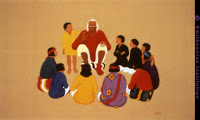
 Storytelling is a device used to pass down histories, lessons, and traditions of a people through written or oral stories. Native Americans have a long history of storytelling. Historically the Native American Indian culture has had challenges with keeping their cultural artifacts and stories in a place of stability, due to colonialism. Uprooted from their lands and corralled into pockets of temporary housing, divided, retaught, removed, and assimilated or faced annihilation, the Indian people have relied on storytelling to keep their culture alive. Native American authors such as Leslie Marmon Silko, Sherman Alexie, and Louise Erdrich have constructed stories that hold true to their culture, while transcending time and landscapes to the contemporary society of the Native American culture.
Traditionally when people think of Native American storytelling the first thing that comes to mind is the stories told to children in the school of the first Thanksgiving. There are pleasant pictures of pilgrims and Indians coming together to teach each other how to harvest fruits and vegetables in order to break bread and establish the land of the savages. Not only is this harmful, but this iconic representation of the Native American people is exactly what their culture has been fighting against since those early days of colonialism. In Call That Story Back, Leslie Marmon Silko refers to these pilgrims that “came from far far away” as “witch people.” (Vizenor, 1995) The innocence of the Native American character, trusting that the white man as they called everyone who was not Native American, wasn’t there to do them harm, but just a new face on their land. Sherman Alexie writes in Before We Knew About Mirrors, about the Indian boys looking at the faces of the white man and of the other Indian children looking at the reflections and similarities, trying to wrap their heads around the new characters in their story. These white faces and assimilated Indian faces, these witch people, were introduced characters into their stories of Native American life that they hadn’t anticipated being part of their story.
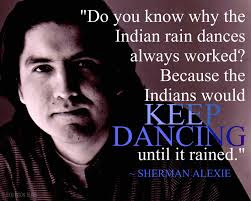
The Native American story up until the white man’s entrance into their world was one of nature, landscapes, tribal traditions, and ancestry. Oral storytelling kept the Native American histories and lessons available to any of the tribe members, so when the white man took everything from them, the stories went with them. When Luther Standing Bear told the story of My People, the Sioux, about the Carlisle Indian School and the early days of the boy’s arrival there, he spoke of his people back East on the reservation. Standing Bear’s father told him “Son, be brave and get killed,” which was a lesson his father had learned and passed down to his son. (Vizenor, 1995) Although Standing Bear decided his father was wrong, it was based upon his own experiences at the Carlisle School and not his father’s experiences. His father’s lesson was one to be heeded, but since Standing Bear was accepting of the white man’s lessons at the school he was not under threat of harm. By the end of the story, Standing Bears’ father is willing to come, dressed in non-threatening attire to visit his son and stays. The story for his father had not changed he just applied that story to the situation in a different way than his son. The change came to the Native American people forced upon them by the white man, but Standing Bear and his father demonstrate the true nature of the Indian culture by rising above the oppression, getting what they could out of the experience and demonstrating civil behavior, contrasting the white man’s opinion of their culture. Luther Standing Bear’s story squashes the stereotype of the savage Indian. His story brings the Native Americans into contemporary American culture, taking their place at the table and states that they have not only manners but if given the opportunity have many things to share with them. Leslie Marmon Silko saw in her observation of the white man on Indian land as having no place regardless of who was being civil. Silko saw history, from storytelling that didn’t have any “white people in the world.” (Vizenor, 1995) A struggle began between her people and the white man because her people were willing to be brave and die for their lands. For Silko, the struggle was all there was that stood between regaining her people’s rightful lands and making the white man go back to where they came from. Just as Sherman Alexie would agree with this, he believed “white women will break your heart” and “money ain’t worth shit.” (Vizenor, 1995) The life of the Native Americans was being lost to the laws and the people who acted as though they were entitled to the land they said they discovered, but to the Native Americas, they were the people who lied and used a worthless compensation for it.
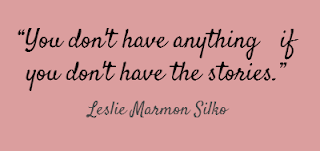
The struggle between the unintended landlords of their land and Native Americans was realized to be a never-ending battle. “In the 1950s, Native Americans struggled with the government’s policy of moving them off reservations and into cities where they might assimilate into mainstream America.” (Decades of Change, 2008) From the early days of the Carlisle school to the “one-room house near the Catholic Church,” and across the “stolen rivers and mountains,” Leslie Marmon Silko, Sherman Alexie, and Luther Standing Bear tell stories about the Native American people’s struggle with the white man. (Vizenor, 1995) Originally by battle and musket, then onto laws of the white man’s government, the Native American voice has been pushed further and further back causing activists to spring up and take a stand, to have their people’s voices heard. For the first time since colonialism took over America, the white man stepped up to the plate and recognized a need to help pay the Native Americans to assist in the reestablishment of their tribes. “The American Indian Movement (AIM), founded in 1968, helped channel government funds to Native-American-controlled organizations and assisted neglected Native Americans in the cities.” (Decades of Change, 2008) The United States had been at war with Vietnam by the time AIM was established since November 1, 1955, and by 1968 was deep in body counts. Ray Young Bear wrote a poem for Viet Nam about being in the Vietnam War. The war had created such a demand for young men to be enlisted that the draft took all able-bodied Americans. Despite Native Americas formerly being treated as lesser than all white men, everybody was involved in the white man’s war in a faraway land against another culture, foreign to both white men and Native Americans. The stories of Native Americas now included integrated stories to be told that no longer were only about ancestors living in tipis and lands being stolen. By “November 1972 AIM brought a caravan of Native Nation representatives to Washington, DC, to the place where dealings with Indians have taken place since 1849,” which changed storytelling by Native Americans from that point on. (Waterman, n.d.) Native Americans were no longer as rejected as African Americans, who were also at this time seeking their own civil rights and acceptance.
Some of the stories that came years after AIM’s development began to reflect the evolving culture of the Native American people. Luci Tapahonso wrote For Lori Tazbah and reflected back on a child that went to public school just like any other child who was naïve and full of wonder. Native American children were told stories like The Earth on Turtle’s Back, which teaches Creationism using typical Native American icons, such as Earth, animals, flowers, and trees. The innocence of the children transcends any culture, so the wonderful and fantastic imagery of Native American storytelling became a tool to use to keep their culture alive. Almost every contemporary classroom across the United States uses Native American storytelling to feed imaginations and teach valuable lessons to children. Sherman Alexie, Leslie Marmon Silk, Luther Standing Bear, and so many others have used storytelling to continue the struggle to keep Native American stories alive, otherwise, they could die and become a footnote in American history books.
References
Decades of Change – 1960-1980. The rise of cultural and ethnic pluralism. (2008). Retrieved from http://iipdigital.usembassy.gov/st/english/publication/2008/04/20080407123655eaifas0.7 868769.html#axzz3kt4llABH
The Earth on Turtle’s Back. (n.d.). Retrieved from http://rtullar.weebly.com/uploads/2/7/7/2/2772102/earth_on_the_turtles_back.pdf
Vizenor, G. (1995). Native American Literature: A Brief Introduction and Anthology. Berkeley, California: Harper Collins College Press.
Waterman Wittstock, L. & Salinas, Elaine J. (n.d.). A Brief History of the American Indian Movement. Retrieved from http://www.aimovement.org/ggc/history.html
 Section 8 Agency
Leave a comment